Brain Graph Super-Resolution
Graph neural network research with Imperial College London — super-resolving brain connectivity graphs using message-passing and fusion strategies.
- |
- Python
- PyTorch
- NetworkX
- Experiment Tracking
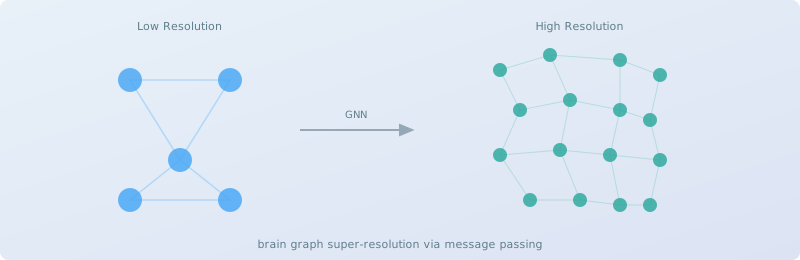
Super-resolving low-resolution brain connectivity graphs into high-resolution representations using graph neural networks and message-passing architectures.
Brain imaging produces connectivity matrices at varying resolutions depending on acquisition protocol and atlas parcellation. This research develops graph-learning methods that predict fine-grained connectivity from coarse inputs, enabling richer downstream analysis without additional scanning. Lead co-author with Dr Islem Rekik, coordinating ~20 co-authors across experiments and reproducible pipelines.
Key Aspects
- Graph-based learning — implemented message-passing GNN variants in PyTorch and NetworkX for brain graph super-resolution.
- Fusion strategies — explored multi-resolution graph fusion and scaling approaches for combining information across brain parcellations.
- Rigorous evaluation — calibration metrics, error analysis, and task-outcome evaluation to ensure clinical relevance of predictions.
- Interpretability — visualisations for understanding which connectivity patterns the model learns to reconstruct.
- Reproducibility — maintained experiment tracking and code quality standards for reliable, shareable research artefacts.